
Conversations: Arnauld Pierre
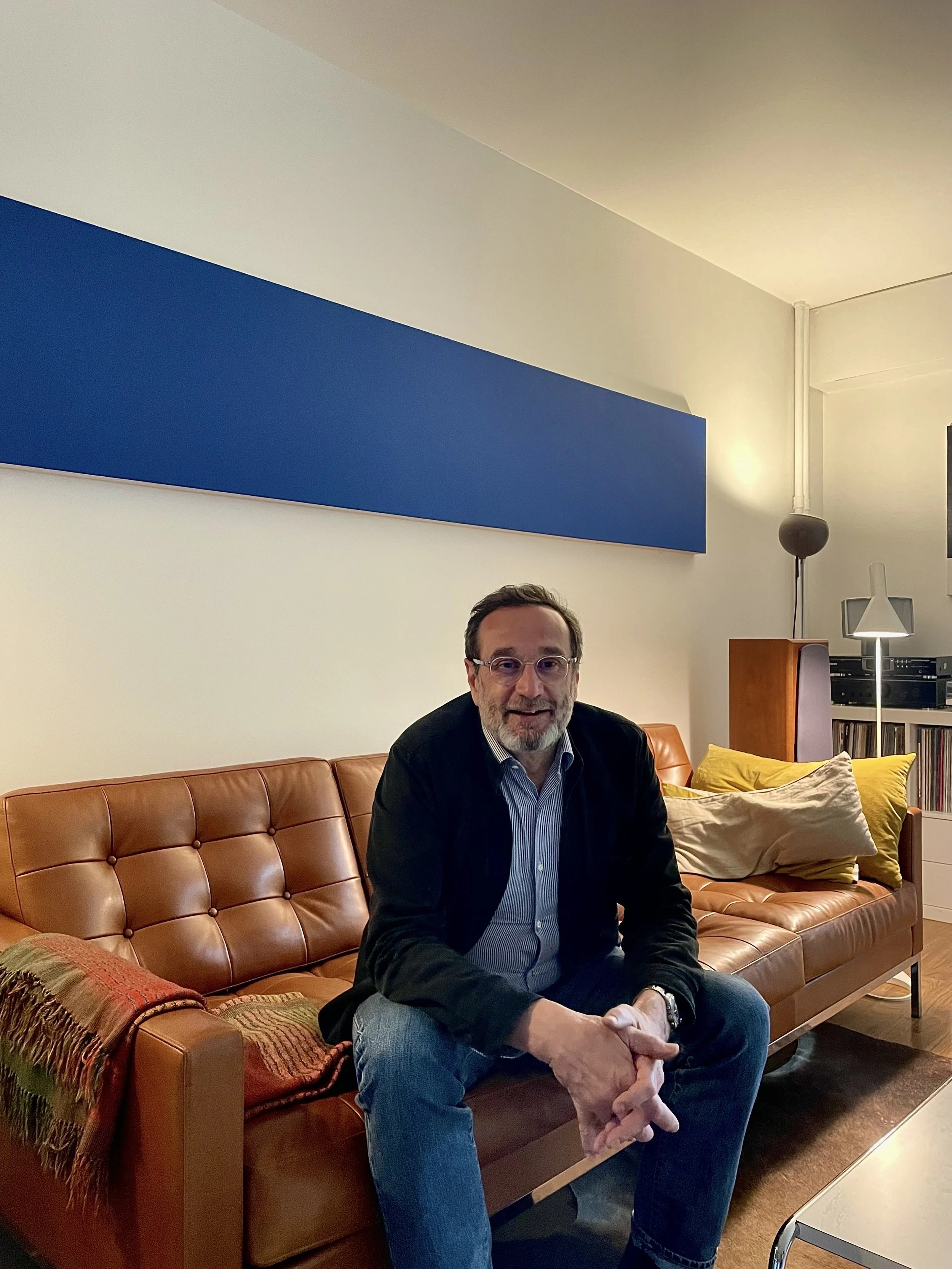
I sat down with Arnauld Pierre, author, curator, professor of art history and leading scholar of abstraction in the wake of modernism, postwar art and optical-kinetic art to speak about what happens when scholarship becomes currency in the gallery world and how museums can never truly be neutral. From Cruz-Diez’s real estate dealings to the curious case of Vasarely’s stalled comeback, Arnauld maps the tangled circuitry between academia, museums and the commercial art machine.
Our conversation was part of a series of interviews in the context of a research project exploring the dynamics of (private) museum interaction with the art market and contemporary iterations of arts patronage.
It’s a race, really. Sometimes public institutions lead, sometimes private ones do. You’ll find strong and weak curatorial choices in both.
LW: What is your experience with the deliberate blurring between museum and commercial gallery functions - especially with mega-galleries - who hire academics like you to curate and write like with the Picabia show at the start of this year?
Arnauld: My collaboration with Hauser & Wirth was fantastic. I had a list of works I’d always wanted for a Picabia show (opened in Paris January 2025), and all I had to do was ask—they did all the legwork. It was brilliant on that level. They also insisted on a proper catalogue, a real book, so I wrote a text with the Picabia committee that easily could’ve appeared in a museum publication.
LW: I still find it fascinating: a commercial gallery inviting you to stage a museum-quality exhibition. Was it primarily a selling show?
Arnauld: Mostly loans. Only a handful of works were for sale, but those few, if sold, would cover the cost of the entire operation. That balance was the idea; a blend of both worlds, and yes, it was very much their request to create something of institutional calibre.
LW: Whatever the motifs may be, I’m here for it. The quality speaks for itself.
Arnauld: Absolutely. And I was proud of the catalogue. It was produced by a proper publishing house and the process was rich with real dialogue and editorial rigour. Frankly, I’ve had far less constructive exchanges working with certain museums. That was the surprising part, commercial structure offering more intellectual depth than public institutions sometimes do. In public galleries today, the quality of exhibition catalogues can be very hit or miss. Scientific ambition has waned, the texts are often too short or superficial. If public institutions don’t step up their game, they’ll soon be eclipsed. It’s hard to believe, when there was a time where galleries were dismissed as mere merchants.
LW: Let me take your observation a little bit further: in her book Museums and Wealth, Nizan Shaked has this table where she argues that curatorial decisions in public museums are balanced, neutral, circumspect, unlike private museums because they are accountable to the people, the state, the whatever. Private institutions are purely market-driven. But if you actually look at what’s happening, especially here in Paris over the last five to ten years - there’s mediocrity and brilliance on both sides. Sometimes small, niche exhibitions, not very accessible to broad audiences are part of the programming, sometimes things go in the opposite direction, in both kinds of institutions.
Arnauld: It’s a race, really. Sometimes public institutions lead, sometimes private ones do. You’ll find strong and weak curatorial choices in both. Take the Pinault Collection’s Corps et Âmes—the theme wasn’t new, the works didn’t move me, a whole room was dedicated to Marlene Dumas for no discernible reason…
LW: To show the collection.
Arnauld: Maybe it’s just not my taste. But compare that to the Pompidou’s Paris Noir, a really rich, well-thought-out show. The quality can be very up and down on both ends. Ultimately, it's the approach, not just the topic. The Hockney exhibition at the Pompidou, just before the pandemic, was another standout.
LW: Then you were lucky. I saw the show at the Fondation Louis Vuitton and a third of it were his iPad paintings. Not a fan.
Arnauld: : I was worried about those too. But the Ellsworth Kelly show was brilliant and the Tom Wesselmann show as well. The FLV has the space to pull off something of that scale. Those vast rooms allow for a monumentality, which the Pompidou simply cannot match. The same selection would’ve filled all six floors over there. That spatial luxury lets them develop an exhibition’s theme in a totally different way. The current Minimal exhibition at the Pinault Collection is another interesting case. It it stunning on an aesthetic level but somewhat lacking from an academic point of view: No overarching concept, no chronology, no theory - for a movement that was so decidedly theoretical - and a lot of top tier artists missing: I’m thinking of Robert Morris, Carl Andre, Frank Stella, Fred Sandback… Sol LeWitt for example was only featured with one small drawing I recall. Frankly, it’s a little disappointing for those of my students who are going to discover minimalism through this show, as it does not provide them with anything substantial. On the other hand, this does go to show that public institutions like the Centre Pompidou may still have a niche. I believe that they could have assembled a much more comprehensive presentation, both drawing from history and recent scholarship. Here lies their future, perhaps. So to sum things up: it’s a mixed bag, a competition of sorts, that only enriches the cultural landscape for audiences.
LW: Do you think the new Fondation Cartier building could stir up even more of a rivalry?
Arnauld: That’s an interesting one. Until now, Fondation Cartier was almost a boutique institution, a very niche position within the olymp of exhibition spaces, removed both physically and in terms of its programming: small, eccentric, deeply innovative programming. It always drew audiences though; people loved it. But with this new space, yes, it’s bound to change. The atmosphere will inevitably shift. I suspect they’ll become a bit more mainstream, not necessarily in a negative way, but certainly more conventional.
LW: Yes, the risk is that they feel the need to fill the space with crowd-pleasers, whether groundbreaking or not. It’s like: “We have this spectacular space, so now we have to fill it” – with something.
The real change is in how acquisitions are financed and organised: public museums have adapted by finding even more new allies. The competition is real, but the system is also becoming more collaborative in unexpected ways.
LW: Is there any anxiety in the professional sphere around the rise of private museums in France, like the Pinault Collection, Cartier Foundation or Fondation Louis Vuitton? Audiences clearly love them, I mean but from within the institutional landscape itself.
Arnauld: If we’re talking about the public at large, the reception is overwhelmingly positive. These places are a huge success in terms of attendance. But if you shift the lens to museum professionals, then yes—there’s a certain ambivalence.
LW: I spoke to Joachim Pissarro about this as well. He suggested that although these spaces might create pressure, they also add richness to the institutional fabric of the city and generally coexist quite well with more traditional museums.
Arnauld: That’s true. But of course, traditional institutions do feel said pressure - whether it’s in terms of attracting audiences or accessing resources. Private foundations often have significantly more money at their disposal, which enables them to produce ambitious exhibitions that are simply out of reach for many public museums. So that will create some mixed feelings. But there’s another dimension too: who’s running these new spaces? Often, it's ex-curators from public museums - people who were excellent at what they did and who’ve now moved to foundations where they have more generous budgets, greater curatorial freedom, and more agile structures. This makes me think of the Charles Ray exhibition a few years ago. It was originally initiated by the Centre Pompidou, but the scale of the works made it financially unfeasible. Eventually, a partnership was struck with the Pinault Collection, and the show was mounted simultaneously in both venues. This kind of collaboration tells you a lot about how the dynamics are shifting.
LW: That competitive element is interesting, especially in France, where there’s such a strong tradition of public funding for the arts. But these private museums often offer better salaries and working conditions to their poached curators, making programming potentially more exhiting. Outside of that, I’ve heard people describe the acquisitions process as “a bloodsport” now, where public museums are priced out of the market. Still, many galleries seem willing to offer discounts for the prestige of having a work in a national collection. Would you say the system is unfair? Or not so bad after all?
Arnauld: Dealers and artists do see the benefit of having their work in major public institutions, so discounts are still extended. And crazy prices are not a recent development tied to private museums; they’s been around for a while now. Budgets remain tight and the market keeps developing. For example, the Centre Pompidou has around two million euros annually for acquisitions, which is modest given current market prices. So, public museums now rely heavily on support committees like the American Friends of this and that.. These groups pool resources to help the museum acquire works that reflect the cultural values they want to champion. For a dedicated collector, having a major piece housed in the Pompidou is a powerful incentive. This is an adaptation to a market that is becoming more and more competitive, with or whithout private museum budgets. The real change is in how acquisitions are financed and organised: public museums have adapted by finding even more new allies. The competition is real, but the system is also becoming more collaborative in unexpected ways.
The best way to be neutral would be to buy absolutely everything.
LW: You mentioned the acquisition committees. Their selection process can be a point of contention. One of the core anxieties seems to be that we’re seeing a growing standardisation of private museum collections. The fear is that this contributes to a narrower, less diverse canon. But hasn’t that always been the case? If we look back at collections from the 18th or 19th century, they too were shaped by what was all the rage at the time. Circling back to my point about Shaked’s work: do you think neutrality and balance in collecting are even possible? After all, behind every collection - public or private - there’s always a personal affectation.
Arnauld: The best way to be neutral would be to buy absolutely everything. (Laughs)
LW: Alphabetically.
Arnauld: And then wait for history to sort through everything. Jokes aside, there’s no such thing as neutrality, especially not when it comes to the state. A collection, whether public or private, will inevitably reflect the tastes, ideologies, and interests of its moment. It’s a kind of portrait or snapshot in time, even if not intended as such. What stands out to me though is that even today, with the sheer number of collectors active in the art world, we don’t necessarily see more diversity. You’d need a sociologist to map it properly, but I think there’s a lot of mimetic behaviour: if one collector buys a particular artist, others quickly follow. It becomes race of who has access to what, not necessarily a journey towards artistic pluralism.
LW: This isn’t just anecdotal: there was a small study recently that confirmed this kind of standardisation. And that’s one of the broader criticisms: that these collections are increasingly market-driven. By acquiring certain artists, collectors inflate their value and market logic ends up influencing what gets canonised. There’s still this lingering belief that public museums could operate outside of that system, that they might offer a kind of corrective to market forces. But that feels increasingly tenuous - and I know that’s a question you’re quite involved in. The moment a museum expresses interest in an artist, it legitimises that artist in a particular way, and that inevitably affects prices.
Arnauld: Yes, the question is: what comes first? The museum or the market? Sometimes the museum leads and the market follows, and sometimes it’s the other way around.
LW: It’s this kind of endless washing machine of approval.
Arnauld: A good example: I was in New York recently and all main exhibitions at the four most prominent modern and contemporary art museums were all devoted to artists represented by one and the same gallery. That’s more than a coincidence.
LW: Have you ever experienced writing something about an artist, and a year or two later they’re suddenly everywhere, in every museum? Like you accidentally set a trend?
Arnauld: Oh, galleries have definitely paid attention to what I’ve written. Sometimes they even commission texts directly, though that’s rare. More often, back in the 2000s when I was publishing substantial yearly volumes with essays and studies on contemporary art, galleries wouldn’t purchase the book, but they would try to get the PDFs via the artist, to post on their websites, to promote, to lend academic weight.
LW: To demonstrate there’s critical interest and research into the artist’s work.
Arnauld: It is peculiar isn’t it? They love the scholarship, the credibility - but not necessarily enough to pay for the publication or share it with collectors. That says a lot about how intellectual work is valued. One case where I did see a clear market impact was an exhibition I curated in 2005 on kinetic art. It was one of the first major shows on the subject, and really marked the beginning of a resurgence. That culminated in the “Dynamo” show at the Grand Palais in 2013, which was a massive success. During that period, the prices for kinetic artists skyrocketed. I saw it with my own eyes. Artists like Soto or Cruz-Diez had up until then been doing reasonably well, but nothing extraordinary. In the 1990s he [Cruz-Diez] was selling parts of the building his studio was in just to keep afloat. Then the market came roaring back. I remember asking about a specific work in 2004 and two years later, the exact same piece at the same gallery had doubled in price.
LW: And the reverse?
Arnauld: Vasarely. I co-curated a major exhibition at the Pompidou in 2019. We believed it might spark a resurgence in the market: Vasarely was one of the most celebrated and valuable artists through the ’60s and ’70s, even into the ’80s. Prices were low at the time of the show, certainly relative to his historical importance. But the show, despite being a huge public success - one of the most visited at the Pompidou - had almost no impact on the market. The reasons weren’t aesthetic or institutional, though. The Vasarely estate is notoriously complex, and the lack of clarity around ownership and works being contested made collectors nervous. It’s a reminder that the market reacts to many things, critical/academic interest is just one piece of a much larger puzzle.
Some collectors are simply very passionate about promoting a particular kind of art, sometimes art that otherwise doesn’t get a lot of attention.
LW: What do you think motivates the private collector turned museum founder? I’m not talking about corporations, there the incentives are fairly transparent. But when it comes to private individuals, there’s a whole range of wilder theories: control, tax optimisation, vanity…what’s your view?
Arnauld: All of those are perfectly valid motivations. But there’s also the possibility of a more straightforward, intellectual or aesthetic drive behind it. Some collectors are simply very passionate about promoting a particular kind of art, sometimes art that otherwise doesn’t get a lot of attention. Take Antoine de Galbert, for example, and his now-defunct Maison Rouge. His collection wasn’t mainstream in the slightest—it centred on artists with ties to surrealism, Dada, art brut, and those on the margins in general. It’s not quite my taste, but I have to say: it was a clearly articulated vision, the product of a man deeply knowledgeable in that field. He had the means and the connoisseurship to create something genuinely interesting. The museum closed a few years ago, but does that make it a failure? I wouldn’t say so. Perhaps he simply grew tired of the problems that come with running such an institution. But his collection didn’t vanish; it continued to circulate through exhibitions elsewhere. He’s an example of someone with no commercial agenda, just pure, sustained passion.
LW: That’s as good a reason as any. But there’s been a lot of debate lately about the long-term sustainability of these passion-driven founder museums. They’re often deeply tied to one person’s vision and when that person steps back or funds dry up, the whole project can unravel. And if the collection is a little too niche or eccentric, it’s hard for larger public institutions to absorb or preserve it. At the same time, these private initiatives can be incredibly powerful: showing work that public museums wouldn’t necessarily have the freedom or funding to programme. But they do create a bit of chaos for established institutions that suddenly find themselves operating within a new kind of dynamic.
Arnauld: That’s an excellent analysis.
LW: I’m honestly just winging it at this point.
Arnauld: [laughs] There’s a foundation in the south of France, on an island—I’ve never visited it.
LW: On Porquerolles? The Carmignac Foundation?
Arnauld: Yes, that’s the one. Apparently, it’s extraordinary. The collection itself isn’t what you’d call mainstream. The founder used to buy in a highly unconventional way, though these days, I hear he’s moved towards more commercial works. He runs a major cabinet conseil financier, and it’s no coincidence that the foundation carries his name. In a way, it’s the complete opposite of Antoine de Galbert.
LW: So vanity?
Arnauld: And probably a touch of personal branding.
Statements from this conversation may not be used for any other purpose or by anyone else without the consent of Arnauld Pierre and Louisa Krämer-Weidenhaupt.